
By Dako
The word usually arrives in a sentence that also contains a deadline. Some office on the Japanese side of your life, a city hall, a bank, a legal affairs bureau, asks for a US document, and then adds the qualifier: with an apostille attached. If your first move was to search what that word even means, this post is the one I wish had come up.
We’ve been through it once, start to finish, with a federal document and a mailbox and a calendar that turned out to matter more than anything else. Here’s what an apostille actually is, how the US system hands them out, and the one lesson from our own round trip that I’d put above all the others. It isn’t about speed.
A certificate about the certificate
An apostille is not a fancier version of your document. It’s a separate certificate, attached to your document, that answers exactly three questions for a foreign government: is this signature real, did the person who signed have the authority to sign, and is this seal genuine.
That’s the whole job. An apostille certifies where a document came from, not whether anything written in it is true. Nobody at any government office reads your birth certificate and confirms you were, in fact, born. They confirm that the registrar’s signature is the registrar’s.
The system comes from the 1961 Hague Convention, which replaced an older and much worse ritual: carrying your document through a chain of certifications that ended at a consulate. Between member countries, the single certificate does the work of the whole chain. Japan has been a member since 1970 and the US since 1981, which is why a US document with an apostille can be presented in Japan without a trip through consular legalization.
One asymmetry worth knowing early: whether a given Japanese office wants an apostille at all is that office’s call. Some procedures ask for one, some accept plain certified copies, and the requirements can differ between two city halls an hour apart. The only reliable move is to ask the specific office that will receive your document, in writing if you can. We’ve written before about how much of Japanese bureaucracy works this way, and the apostille question is no exception.
Federal or state: the fork you have to get right
The US doesn’t have one apostille office. It has one federal office plus every state’s Secretary of State, and your document decides which one you’re allowed to use.
Documents issued by a federal agency, or signed by a federal official, go to the US Department of State’s Office of Authentications. State-issued documents go to the Secretary of State of the state that issued them. That second track covers most of the paper a family actually owns: birth certificates, marriage certificates, state court records, and anything notarized by a state-commissioned notary.
Getting this fork wrong is the most expensive beginner mistake, because nothing happens quickly on either track. Mail a state birth certificate to the federal office and you can expect it back unprocessed. Weeks spent learning where it should have gone.
Ours was a federal document, so what follows is the federal track firsthand. If yours is state-issued, the structure is the same but the details live on your state’s Secretary of State website, and fees and turnaround vary by state.
How the federal track works, step by step
As of August 2026, the Department of State’s published process looks like this. Check the current version of their pages before you mail anything, because fees and timelines move.
- Confirm your document qualifies for the federal track and that the destination country is a Hague member. Japan is.
- Fill out Form DS-4194, the request cover sheet.
- Include payment. The fee is $20 per document, by check or money order for mail-in requests.
- Include a prepaid, self-addressed return envelope. The office specifies USPS or UPS for the return leg.
- Mail the package to the Office of Authentications in Sterling, Virginia, and wait. The published estimate for mail-in processing is about five weeks from when they receive it.
The office itself recommends trackable mail, and our house treats that as a law of nature rather than a suggestion. Both directions, no exceptions. You are mailing an original document you may not be able to easily replace, into a queue you cannot see, and the tracking number is the only thread connecting you to it. We used Priority Mail with tracking on the way out and prepaid tracked postage on the return envelope, and I checked that number more often than I’ll admit in print.
Our real timeline: one and a half to two months
The five-week estimate is the processing time once your envelope reaches the right desk. It is not the answer to the question you actually have, which is: how long from the day I start until the apostilled document is back in my hands?
For us, measured from sending the request to holding the returned document, the answer was about one and a half to two months. Mail time out, intake, processing, mail time back. Nothing went wrong. No rejections, no lost envelopes. Roughly two months is what it looks like when everything works.
I want to sit on that point, because every official page quotes its own segment of the pipeline and nobody quotes the whole pipe. If a Japanese office is waiting on this document, the number that matters is door to door. Plan with ours, not with the five weeks.
The validity window: why timing beats speed
Here’s the part that reorganized our thinking, and the reason this post exists.
An apostille doesn’t expire. The Hague Convention gives it no shelf life, and US state authentication offices say so directly. But the office receiving your document can impose its own freshness rule on the document underneath, and Japanese institutions often do. A receiving office can ask that a certificate be issued within some recent window before submission. To give a public example of how short these windows run: the affidavit that the US Embassy in Tokyo issues for marriages in Japan is valid for three months from signing, per the embassy itself.
Now put the two numbers side by side. A document that has to be freshly issued, and a certification round trip that took our household up to two months. The window and the pipeline overlap almost completely.
That was our experience in one sentence. The office receiving our document wanted it recently issued. So we stopped asking “how fast can we get the apostille” and started working backward from the submission deadline, with the full two-month round trip penciled in. Order the underlying document as late as you safely can, send it for the apostille immediately, and know before you start what date makes the whole effort worthless. Too early is a real failure mode here, not just too late. A document obtained a year ahead “to be safe” can age out of its window while sitting in your drawer being safe.
Speed is not the skill. Sequencing is the skill.
What ours looked like, and what to check
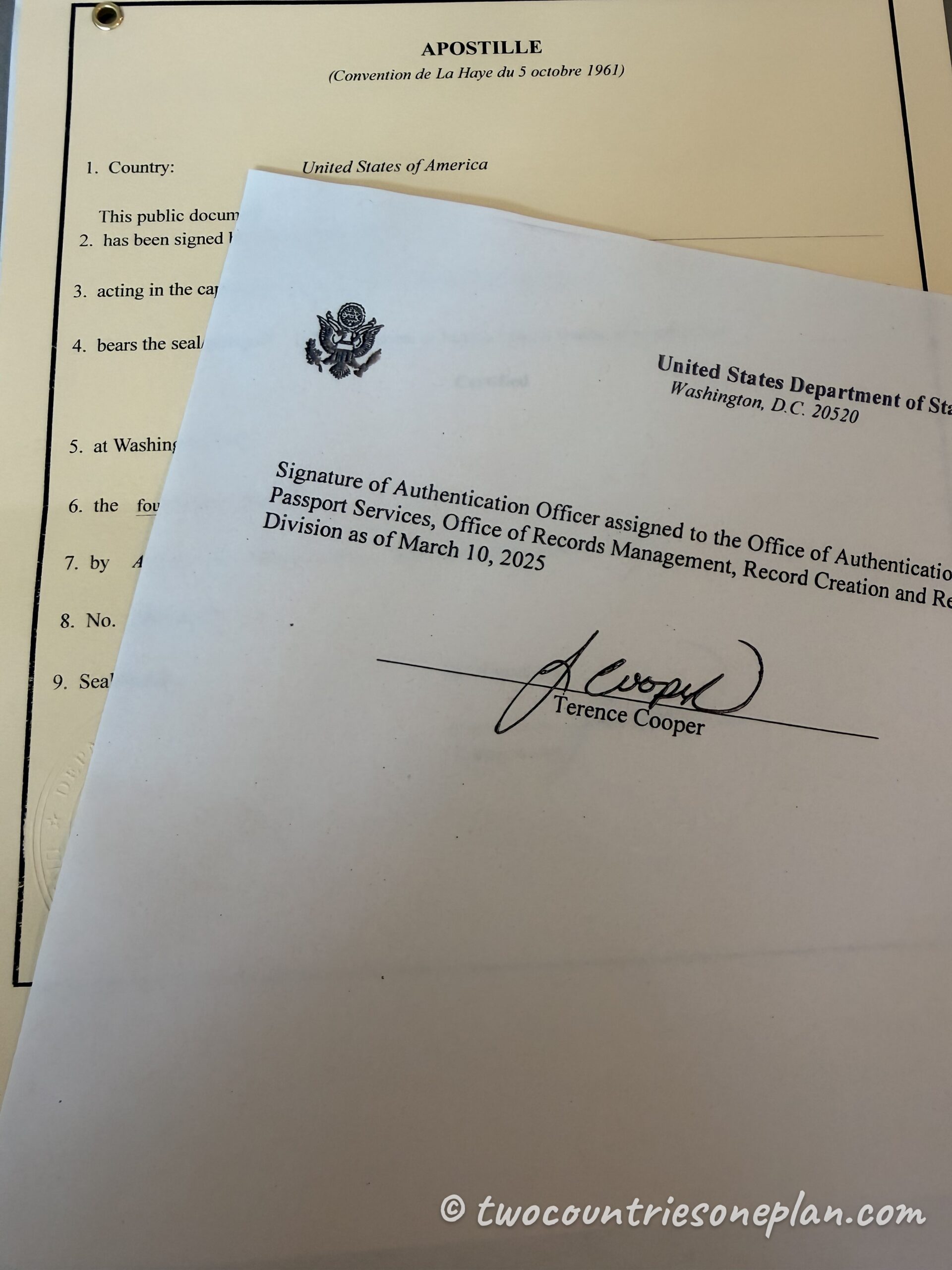
That’s our actual federal apostille in the photo: a full page, stapled to the document it certifies, with numbered fields laid out by the Convention and the seal of the United States Department of State.
When yours comes back, check it while the return envelope is still in your hand. The staple matters, so resist any urge to detach the certificate from the document, because they function as a unit. Confirm the certificate actually references your document type and signer. And before anything crosses the Pacific, remember the last step that surprises people: Japanese offices generally want a Japanese translation of the foreign document you submit. In many procedures the translator doesn’t need to be a professional. A competent person, including you or your spouse, can translate and sign the translation, though this too is worth confirming with the receiving office. In our house, the translation layer has a name, and she wrote this post.
One small map note for the reverse trip: when it’s a Japanese document that needs to be used in the US, the apostille comes from Japan’s Ministry of Foreign Affairs, not from any US office.
FAQ
Do I always need an apostille to use a US document in Japan?
No. The receiving office in Japan decides what it requires, and requirements differ by office and procedure. Ask the specific city hall, bureau, or bank that will take your document before you spend money or weeks. If they do require certification and the country pair is US–Japan, an apostille is the form it takes.
How long does a US federal apostille take?
The State Department’s published mail-in estimate is about five weeks of processing as of August 2026. Our full door-to-door experience, from sending the request to receiving the document back, was one and a half to two months. Budget for the longer number.
Does an apostille expire?
The apostille itself doesn’t. But the office receiving your document can require that the underlying document be recently issued, and those freshness windows can be shorter than the time it takes to get the apostille. Work backward from your submission deadline rather than starting from “as early as possible.”
This article is general information about document authentication for US–Japan procedures, not legal advice. Requirements are set by each receiving office and change over time, so confirm current fees, forms, and rules with the US Department of State, your state’s Secretary of State, and the Japanese office you’re submitting to. See our Disclaimer for details.